
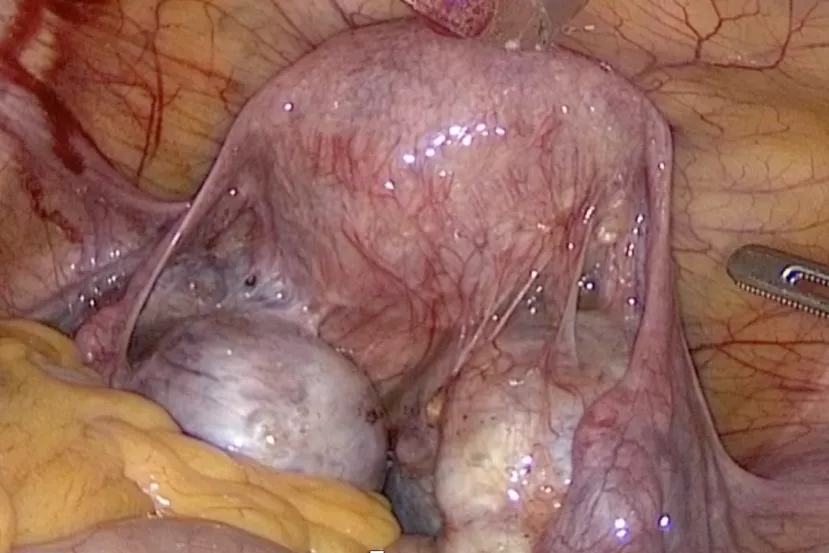

By the time most Indian women receive an ovarian cancer diagnosis, the disease has reached Stage III, meaning it has spread beyond the ovaries to the peritoneum, the abdominal organs, or the regional lymph nodes. The natural reaction is that the disease is “too far gone for surgery.”
That reaction is wrong, and it matters because Stage III ovarian cancer is one of the conditions where surgical decision-making most directly determines outcome. This article explains what surgery at Stage III actually does, when it’s the right next step, and how to think about the surgery-first versus chemotherapy-first question.
Why surgery is central in advanced ovarian cancer
Ovarian cancer, unlike most other cancers, spreads largely by surface dissemination, cancer cells seed the inner lining of the abdomen (the peritoneum) and grow as small nodules on the surfaces of organs. This spread pattern is what distinguishes it surgically: even at advanced stages, the disease often remains technically removable in selected patients.
The single most important determinant of long-term outcome in Stage III ovarian cancer is surgical completeness, specifically, whether all visible disease can be removed at the end of the operation. The standard metric:
- CC-0 (complete cytoreduction), no visible residual disease
- CC-1, residual disease nodules less than 2.5 mm
- CC-2, residual disease nodules 2.5 mm to 2.5 cm
- CC-3, residual disease larger than 2.5 cm
Five-year survival drops measurably with each increment of residual disease. CC-0 cytoreduction approximately doubles long-term survival compared to CC-3 in published series, even with identical adjuvant chemotherapy.
This is the central insight: in Stage III ovarian cancer, the surgeon’s skill at achieving complete cytoreduction matters more than almost any other variable. It matters more than the chemotherapy regimen. It matters more than the centre’s prestige. It matters more than the operating system the hospital uses.
What complete cytoreduction actually involves
Cytoreductive surgery, sometimes called “debulking surgery”, for Stage III ovarian cancer is typically a long, complex operation. Depending on the distribution of disease, it can include:
- Bilateral salpingo-oophorectomy and hysterectomy
- Omentectomy (removal of the fatty apron over the bowel)
- Peritoneal stripping from the diaphragm, pelvis, and abdominal sidewalls
- Bowel resection with anastomosis if disease involves bowel
- Splenectomy if disease involves the splenic hilum
- Partial liver resection or diaphragm resection for surface disease
- Pelvic and para-aortic lymph node dissection
The operation can take 6–12 hours. The hospital stay is typically 7–14 days. The recovery period is significant but tolerable with structured rehabilitation. This is why the operation is performed at high-volume centres with dedicated ICU, surgical, and rehabilitation infrastructure.
The intent is curative for selected patients, even at Stage III. This is the part patients and families consistently underestimate.
Surgery first vs chemotherapy first, the central decision
The biggest decision in Stage III ovarian cancer management is the sequence:
Primary debulking surgery (surgery first), followed by 6 cycles of adjuvant chemotherapy
Neoadjuvant chemotherapy (chemo first), typically 3 cycles, followed by interval cytoreductive surgery, followed by 3 more cycles of chemotherapy
Both pathways have strong evidence supporting them. The choice depends on:
- Disease burden and distribution, extensive upper-abdominal disease (liver surface, diaphragm, splenic hilum) often favours chemotherapy first to “downstage” before surgery
- Patient fitness, comorbidity, performance status, nutritional state
- Predicted surgical completeness, if the team predicts CC-0 is achievable at the first surgery, primary debulking is preferred; if not, neoadjuvant chemotherapy gives a better chance of CC-0 at the interval surgery
- Team experience, sub-speciality centres with the experience to safely perform complex upper-abdominal cytoreduction may favour primary surgery; centres without that experience appropriately favour neoadjuvant
The decision should be made by a multidisciplinary tumour board, not by the first specialist a patient sees. If this decision is being made without tumour-board review in your case, request one.
When HIPEC enters the picture
For patients undergoing interval cytoreductive surgery after neoadjuvant chemotherapy, the addition of HIPEC (hyperthermic intraperitoneal chemotherapy) at the time of interval surgery has been shown to improve both recurrence-free and overall survival in the OVHIPEC-1 trial. This is now incorporated into international guidelines as a Category 2A option for this specific patient subset.
HIPEC is not routinely added to primary debulking surgery, the evidence base does not yet support it in that setting. And HIPEC is not appropriate for patients who cannot achieve complete cytoreduction.
The selection rules:
- Stage III epithelial ovarian, fallopian tube, or primary peritoneal cancer
- Interval cytoreductive surgery setting
- Complete or near-complete cytoreduction expected
- Patient fit enough for the additional 90-minute procedure
- Centre with the experience and infrastructure to perform HIPEC safely
Advanced ovarian cancer surgery including HIPEC is now available at a small number of Indian tertiary centres, including in Ahmedabad. Indian patients no longer need to travel to Mumbai or Delhi for HIPEC when their case meets the criteria.
What happens after surgery
The post-operative pathway for Stage III ovarian cancer is structured:
- Recovery from surgery, typically 7–14 days in hospital, depending on extent
- Pathology review, final staging based on what was actually found at surgery
- Multidisciplinary tumour board re-discussion, confirms adjuvant chemotherapy plan
- Adjuvant chemotherapy, usually 6 cycles of carboplatin + paclitaxel, sometimes with bevacizumab; new options include PARP inhibitor maintenance for BRCA-mutated or HRD-positive disease
- Surveillance, clinical examination, CA-125, and imaging every 3 months for 2 years, then less frequently
The five-year survival in optimally cytoreduced Stage III ovarian cancer in Indian tertiary-centre series is now in the 40–60% range, with newer agents (PARP inhibitors for BRCA-mutated disease) pushing the numbers higher in selected subgroups. These are not the numbers from a decade ago.
What patients can do
Five things that improve the chance of a good outcome:
- Get a sub-speciality opinion before consenting to surgery. Ovarian cancer surgical outcomes differ measurably between gynaecological oncologists and general surgical oncologists. The literature is consistent on this.
- Insist on multidisciplinary tumour board review. If the surgery-first versus chemo-first decision was made by a single specialist in a 20-minute consultation, the decision-making has been incomplete.
- Ask about HIPEC eligibility. Even if HIPEC isn’t appropriate for your specific case, the conversation should happen. If your centre doesn’t perform HIPEC and your case might qualify, ask about referral to a centre that does.
- Get BRCA / HRD testing. Genetic and genomic testing now guides adjuvant therapy choice and has implications for family members. It should be standard at diagnosis.
- Discuss the realistic recovery trajectory. A complete cytoreduction operation is significant surgery. Knowing what 8 weeks of recovery actually looks like, and arranging family and work life accordingly, substantially improves the experience.
The bottom line
Stage III ovarian cancer is a serious diagnosis but it is not a sentence. The single most important determinant of long-term outcome is complete cytoreduction, performed by a sub-speciality team at a centre with the right infrastructure. The sequence (surgery first or chemotherapy first) and the addition of HIPEC are case-specific decisions that benefit from multidisciplinary review.
If you have just received a Stage III diagnosis, the questions to ask in the first consultation are: who is going to perform the surgery, what is their predicted surgical completeness for cases like mine, has my case been to a tumour board, and what is the planned sequence and adjuvant therapy. The answers to these four questions tell you most of what you need to know about the trajectory ahead.
About the author
This article was reviewed by Dr. Nishtha Tripathi Patel (MBBS, DGO, DNB, Fellowship in Gynaecological Oncology, ESGO-certified), an ESGO-certified gynaecological oncosurgeon in Ahmedabad with published academic work on cytoreductive surgery, HIPEC, and recurrent ovarian cancer. Reach her practice at +91 76988 00333.

Comments are closed.